
At F.A.T. Lab, we think of technology as a cultural material. Code carries ideology. Interfaces shape belief. Systems teach us how the world works. That is why we pay close attention when new institutions emerge to frame what creative work with AI is supposed to be.
The AI Creative Future Awards were founded to do exactly that. Rather than treating artificial intelligence as a novelty or a productivity hack, the awards focus on work that interrogates authorship, aesthetics, memory, and power in an era of machine collaboration. The goal is not to reward polish alone, but to recognize projects that think critically about what creativity becomes when algorithms participate in cultural production.
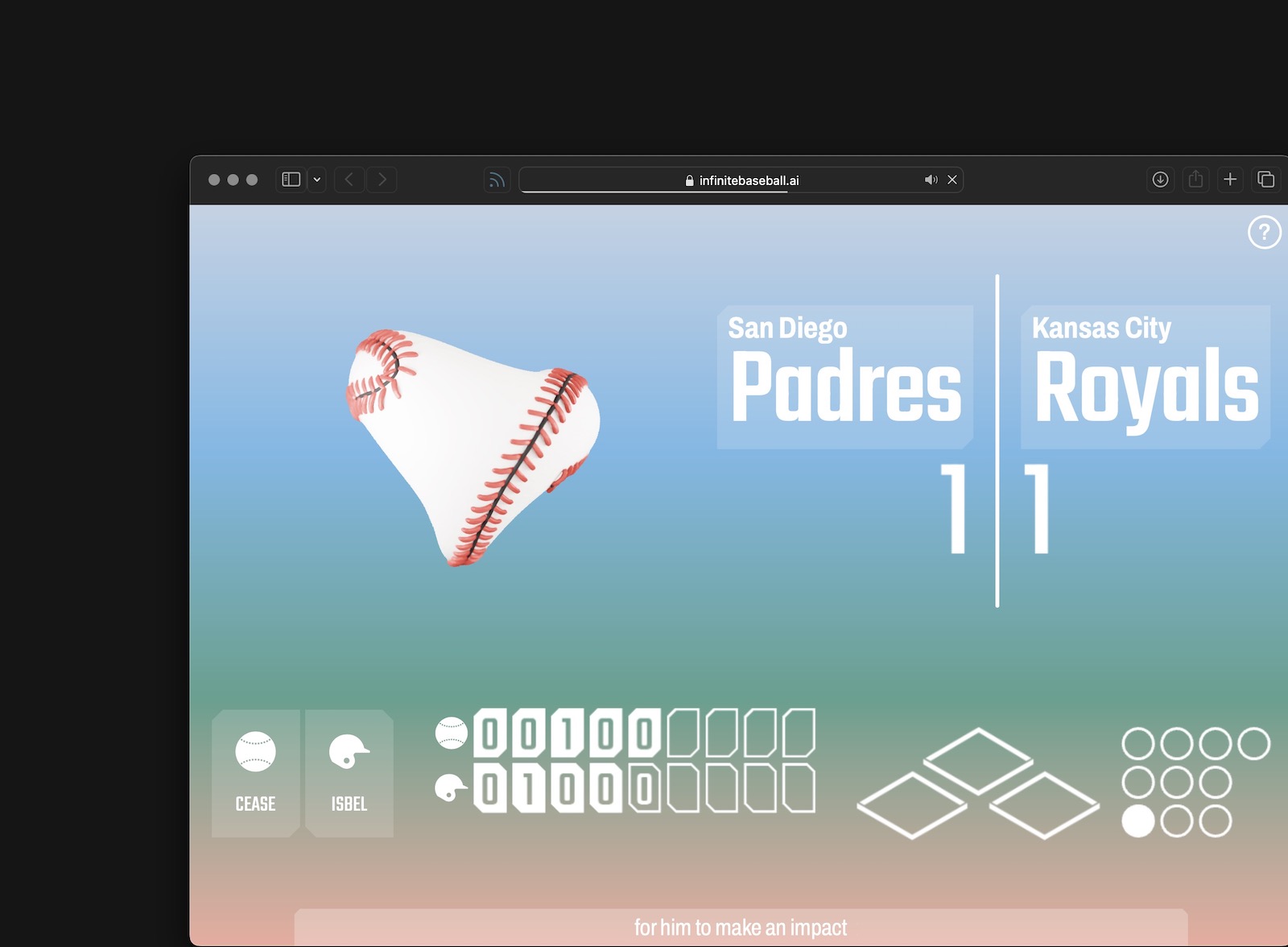
Our Fellow F.A.T. Lab degenerate Dan Moore was honored by the AI Creative Future Awards this past December for his generative AI work The Great American Pastime. The piece reimagines baseball, one of America’s most deeply ingrained cultural rituals, as an infinite, machine generated radio broadcast. Games unfold pitch by pitch through synthetic play by play commentary, drawing from decades of statistics, narrative tropes, and the familiar cadence of sports radio.
At first listen, the work feels comforting. It sounds like memory. It sounds like summer. But over time, something stranger emerges. The games never end. The voices never tire. The nostalgia is real, but it is also automated. What was once a shared human ritual becomes a continuously running system, endlessly replaying the signals of tradition.
This tension is the core of the work. The Great American Pastime is not simply about baseball. It is about how culture is encoded, replayed, and abstracted by machines. It asks what happens when storytelling becomes procedural, when memory is statistical, and when authenticity is simulated at scale. The piece does not offer easy answers. Instead, it invites listeners to sit with the discomfort of recognition and artificiality existing at the same time.
The AI Creative Future Awards recognized this critical stance. In a field crowded with spectacle, the work stands out for its restraint and its conceptual clarity. It treats AI not as a replacement for creativity, but as a mirror that reflects our systems back at us, sometimes more clearly than we would like.
For F.A.T. Lab, this recognition matters. It aligns with our long standing interest in free art, free technology, and the politics embedded in tools. As AI systems increasingly shape how images, text, sound, and meaning circulate, artists have a responsibility to probe those systems, to stress them, and to reveal their underlying assumptions.
We see The Great American Pastime as part of a broader lineage of work that uses emerging technology to examine culture rather than simply accelerate it. It is slow. It is repetitive. It is unsettling in its familiarity. And it is precisely the kind of project that deserves attention as we collectively negotiate what the future of creative AI should look like.
Congratulations to Dan Moore and to the organizers of the AI Creative Future Awards for creating space for work that asks harder questions. This is the future we want to build.